
Who speaks Lithuanian, and where
About 3 million people speak Lithuanian - in Lithuania, in communities across Europe and the Americas, and as an official EU language. Dialects, regions and the Baltic family.

How many people speak Lithuanian?
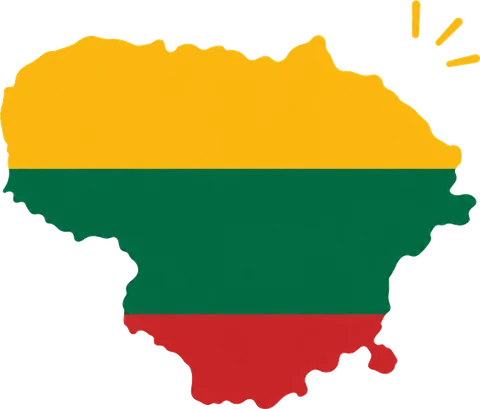
Around 3 million people speak Lithuanian. The great majority live in Lithuania, where it is the native language of most of the population and the only state language - Article 14 of the Constitution says simply "Valstybinė kalba - lietuvių kalba" ("The state language is Lithuanian"). Since Lithuania joined the European Union in 2004, Lithuanian has also been one of the EU's official languages, so EU laws and documents are published in it.
Lithuania is also home to sizeable Polish and Russian-speaking communities, and many Lithuanians speak English, Russian or Polish as a second language - but in public life, schools, media and government, Lithuanian comes first.
Lithuanian around the world
Large waves of emigration - in the late 19th and early 20th century, after the Second World War, and again after 1990 - carried Lithuanian far beyond the Baltic. Today there are Lithuanian communities, Saturday schools and parishes in many countries.

Europe. The United Kingdom, Ireland, Norway, Germany, Spain and Sweden have large recent communities. Historic Lithuanian-speaking areas also exist in north-eastern Poland (around Punsk and Sejny) and in Belarus.

The Americas. The United States has the largest Lithuanian-heritage population outside Lithuania, especially around Chicago. There are older communities in Canada, Brazil and Argentina.
Heritage learners. Many grandchildren of emigrants learn Lithuanian as adults to talk to family, read old letters or move back.
Dialects and regions
Lithuanian has two main dialect groups. Aukštaitian (Highland Lithuanian) is spoken across most of the country, and the standard language is based on its western variety. Samogitian (žemaičių, Lowland Lithuanian) is spoken in the west and sounds so different that other Lithuanians can find it hard to follow; it has its own writing tradition.
Lithuania is also traditionally divided into ethnographic regions, each with its own customs, songs and accents. LearnLT uses them as the levels of its course:
| Region | Where | In LearnLT |
|---|---|---|
| Aukštaitija | north-east, lakes and forests | A1 |
| Žemaitija | west, Samogitian dialect | A2 |
| Dzūkija | south, pine forests and mushrooms | B1 |
| Suvalkija | south-west, base of the standard language | B2 |
| Mažoji Lietuva | Lithuania Minor, by the coast and the Curonian Spit | C1 |
| Vilnius | the capital | C2 |
Explore all six levels on the course page.
Why learn a language spoken by 3 million?
Because those 3 million are your colleagues, partners, in-laws or neighbours. People learn Lithuanian to live and work in Vilnius or Kaunas, to talk with a Lithuanian family, to reconnect with their roots, or simply because it is one of the most fascinating languages in Europe. Lithuanians notice and appreciate even a few words - start with greetings and common phrases.
Questions people ask
How many people speak Lithuanian?
About 3 million people, most of them in Lithuania, with communities in the UK, Ireland, Norway, the USA and other countries.
Where is Lithuanian an official language?
Lithuanian is the only state language of Lithuania and has been an official language of the European Union since 2004.
Can Latvians understand Lithuanian?
Not really. Latvian is the closest related language and many words are similar, but speakers of the two cannot easily understand each other without learning.
More about the Lithuanian language
 Archaic and intactLithuanian: the most archaic living Indo-European language
 Carefully keptHow standard Lithuanian was built and is looked after
 The alphabetAll 32 letters explained
 The 7 noun casesWhat each case does
 PronunciationVowels, consonants and stress
Learn it yourselfA free course from A1 to C2
Start with your first Lithuanian words today
Free account, no credit card. Your progress is saved and you can continue on your phone.
Create a free account